Development status and visual guide
Updated 20 October 2026. This describes 1.0.0, the first release with a compatibility promise. Full iOS parity is not established: the measured differences are open as issues (#70-#73). The owner accepted the navigation selector on 20 October. Historical research remains available; this page identifies which later changes supersede its implementation.
Main after 1.0 (24 October)
- 26 October: the held lens's outline is a squircle (a .7 blend toward n = 3, the exponent iOS's lens fits), not a capsule; its width profile against iOS moves from 27.5 to 7.1 px rms. Evidence.
- 26 October: the held lens's refraction and fringes were rebuilt against the recordings (band 1.1, no seam, split proportional to the shift, spectral rim, narrow transit stretch); fringe energy is now 0.9-1.4x iOS's on four of five recordings, 0.2-0.6x on the long held drag. Evidence; the remaining differences are the audit (#92-#104).
- Material 3 sliders mirror right to left: the fill now grows from the right edge to the thumb, and the range fill sits between the mirrored thumbs (#89). Desktop renders before and after: evidence.
- Custom-path field builds are about 15% faster on the desktop JVM, with bit-identical fields (paired
run of
tools/benchmarks/pathfield). - A resize of a custom-path panel builds its field off composition and keeps the previous field until the new one is ready; the first field and any shape or padding change still build synchronously, so no frame shows the wrong outline. Bit-identical fields; seven new tests hold the build and check every composed frame. A bounded-resolution build (#81) is still open: evidence.
Web demo first load (20 October, #78)
- The demo showed a black page for 7.6 s unthrottled and 30 s on slow 4G on a first visit (a 4.46 MB gzip download, three quarters of it Skia's runtime, then about 2 s per opening frame compiling shaders). A loader now shows within 0.05-0.2 s; the time to a usable app is unchanged. Missing WebAssembly GC, failed downloads and lost WebGL contexts are reported on the page. Chromium only: measurements.
- 24 October: both
.wasmdownloads start with the page (preloaded where WebAssembly GC exists), so Skia is ready 0.34-0.35 s sooner on emulated 4G (4.60 → 4.26 s fast 4G, 23.6 → 23.3 s slow 4G; unchanged unthrottled). Shader compilation is untouched and was not measurable on the software-GL machine used; brotli (22% smaller) awaits a hosting decision. Measurements.
First tap after install (20 October, #71)
- The first tab bar tap after install had one 326-352 ms frame on a Pixel 7: the selector's layers were reallocated as its pad followed the deforming body, and the first frame at a new size compiled a new GPU pipeline for the glass shader (265-286 ms, traced). The pad is now held at its largest: the slowest first-tap frame is 67-91 ms, cold start unchanged (medians 135.5 and 136 ms). The library baseline profile is removed (no measurable gain). Evidence.
Material 3 polish (20 October, #79)
SliderandRangeSlidertracks run under the thumb's whole travel; they stopped half a thumb short of each end.GlassSliderTrackTestpins it. The showcase's mini player is inset from the card's edge and shows a pause glyph; its hero cover is capped at 280 dp on wide windows. Desktop Skia renders before and after, and a Pixel 7 capture: evidence. Browser captures of the web demo (Chrome) show the same fix.
Compose maintenance on main
Issues #80 and #82 are addressed by active nested-theme view lifetime and matching cache/build geometry: whole-pixel size and exact recording-grid padding, including fractional origins at reduced render scales. The first part of #81 adds shader-capability gating and transform-buffer reuse capped at 256k retained pixels (~4.25 MiB). Larger fields use temporary storage. Size-only rebuilds now run off composition (24 October); bounded-resolution preparation remains open under #81. Measurements are desktop allocation evidence, not physical-device frame-time evidence; the first build and shape changes remain synchronous. See verification and limits.
1.0 (20 October)
- Parity scoreboard. All five iOS recordings replayed through the 1.0 build and scored in display colours: resting bar 0 on all five, tap pill +0.8 / -2 (was -8.9 / -7.7), held lens -0.1 / +1 on black pages and -5 over content (was -13), tracking unchanged. No region regressed. Record.
- First use on a Pixel 7. One 317-370 ms frame on the first tap after installing (GPU shader compilation, cached per install); later cold starts 29-65 ms. A library baseline profile ships; it did not change these numbers measurably. Evidence.
- API. Kotlin ABI dumps under
api/, checked in CI. Nothing was deprecated, so nothing was removed.
Qt Quick and Unity (20 October)
- Qt Quick (
ports/qt):GlassSurfaceover a liveShaderEffectSourceof the item behind it. Shaders generated from the production SkSL, compiled withqsband rendered offscreen under Xvfb on Mesa's software OpenGL in CI, with pixel checks. Not checked: a GPU, Windows/macOS hosts, frame timing. Guide. - Unity (
ports/unity): Built-in and URP shaders plusGlassSurface. The generated HLSL compiles with FXC (ps_5_0) and renders on D3D11 WARP in CI; the material equals the CanvasKit port's. Never run in Unity (not installed here): ShaderLab, GrabPass, URP and the component are unverified. Guide.
.NET MAUI (20 October)
LiquidGlass.Maui (ports/dotnet/LiquidGlass.Maui, unreleased) puts GlassSurface over the app's own
MAUI views on Android and Windows. The backdrop is drawn from the element's native view. The demo runs on a
Pixel 7, with the glass following the page as it scrolls. The first device run found that MAUI's
CaptureAsync copies window pixels on Android, so the glass refracted itself; it now draws the view.
Not run: the Windows target (it builds and packs in CI). Not measured: frame timing.
Guide,
evidence.
Flutter on pub.dev (20 October)
The Flutter package is publishable as liquiglass (pub.dev refuses liquidglass as too close to
liquid_glass): pub.dev metadata, a package CHANGELOG, a screenshot, platforms without iOS, and
flutter pub publish --dry-run clean. Its version follows VERSION_NAME (-SNAPSHOT as -dev).
A pub-dev job in the publish workflow publishes each tag through pub.dev's automated publishing, once
the owner's first upload exists (publishing). 1.0.0 was uploaded by hand on
20 October: https://pub.dev/packages/liquiglass.
Flutter (19 October)
liquiglass, liquidglass for Flutter (ports/flutter) puts GlassSurface over the live backdrop on
Impeller: a backdrop filter running the production shader, generated from its SkSL export. The Dart
material equals the CanvasKit port's uniforms to 1e-6, the shader compiles and loads in flutter test,
and the example refracts a scrolling list on the Android 17 emulator (OpenGL ES). Approximated: the
wide tone kernel (thirteen taps). On 20 October it ran on a Pixel 7 on Impeller's Vulkan backend too. Not yet
measured: frame timing. Guide,
evidence.
React Native (19 October)
@shayxo.dev/liquidglass-react-native (ports/react-native, on npm from 0.2.1) puts GlassSurface and GlassLens in a
React Native Skia <Canvas> on Android and React Native Web, with the production shaders: a small
adapter runs the CanvasKit painter unchanged on React Native Skia's API. In React Native Skia's headless
build (CanvasKit, software) the adapter's glass equals CanvasKit's, no channel off by more than 1, and
the components render in an element tree. The demo app runs on the Android 17 emulator (a first run
there found surfaces drawing nothing, fixed by raster offscreen surfaces) and, on 20 October, on a Pixel 7. The backdrop
is a snapshot.
Guide, evidence.
WPF and Avalonia (19 October)
LiquidGlass.Wpf(new): glass over native WPF content. The host's own WPF subtree is captured as the backdrop, and the glass is drawn into aWriteableBitmapunder ordinary WPF labels.WpfDemo --capturerenders it offscreen and checks the pixels; it runs in CI on Windows. Evidence.LiquidGlass.Avalonia(new, .NET 8): the same over native Avalonia 12 content on Windows, macOS and Linux. Avalonia 12 accepts the painter's SkiaSharp 4.AvaloniaDemorenders headlessly with Avalonia's Skia renderer and checks the pixels, in CI on Linux and Windows. Evidence.
Public Compose API (18 October)
The Compose API was replaced on 18 October by one root and one modifier, named after SwiftUI's:
LiquidGlassTheme { App() } around the app, Modifier.glassEffect(glass, shape) on any element,
Glass variants (Regular, Clear, Identity, and the measured Lens, TabBar, Toolbar),
GlassEffectContainer and glassEffectID. GlassTabBar takes no state. The state-and-modifier
API and GlassScene are internal now; the API reference
maps each removed name to its replacement.
Glass is drawn in an overlay above the theme's recording, on every platform, so it never samples itself. Two consequences are open limits: glass draws above content that is not glass, and an ancestor's alpha does not fade it (Limitations). Skia's own backdrop (desktop and web) was considered and set aside on 19 October: it fixes the stacking but blanks glass under any translucent ancestor, which every fade animation creates (spikes). The overlay stays on every platform.
Evidence: GlassEffectTest in the desktop render suite checks that a lens magnifies the page and
not its own content at the top level, under a graphicsLayer and inside a scrolled column; that a
click reaches the element under interactive glass; that Glass.Identity draws no glass; the
stand-in without a theme; merging in a container; and a glassEffectID morph. These are desktop
JVM renders, not a physical-device record; this page links no device record for the new API yet.
Web component (18 October)
<liquid-glass> (ports/npm, npm package @shayxo.dev/liquidglass) brings the material to any
web page or framework as a custom element; its content stays ordinary HTML. engine="html" refracts
the live page with backdrop-filter: an SVG displacement map computed from the shader's own geometry in
Chromium, a frosted blur in Firefox and Safari. It is a CSS approximation of the material, with
inherited numbers checked against the Kotlin sources and the CSS-only values labelled authored.
engine="canvas" draws the production shaders through the CanvasKit painter over a source the page
supplies. Guide.
Evidence: 27 Node unit tests and 7 Playwright tests in Chromium 156 (headless shell), and captures of
both engines in light and dark
(record).
Firefox 157 and WebKit 27.2 (Playwright, headless) upgrade the element, select the frosted path and
run the canvas engine, but their headless builds render no backdrop-filter blur at all, so the frosted
look there is unverified. Not checked: Safari, mobile browsers, a physical device, comparison with iOS.
The ports' surfaces bind Glass.Regular's light, GlassLight.Default (-0.35, -0.94), with a light option (19 October).
Material 3, the plugin and the BOM (18 October)
liquidglass-material3(new artifact): glass versions of the Material 3 components with the same names and parameters (guide). Default look: iOS 26 shapes and motion in the app's colour scheme; bars takelayout = GlassLayout.Material. Dialogs, sheets and menus are drawn in the app's window (GlassOverlay), so their glass refracts the app behind them. The tab bar, segmented controls and tab rows use the measured Calm tab bar; the other components' looks are authored, not measured against iOS.liquidglass-bom(new) and the Gradle plugindev.shayxo.liquidglass(new): one line adds the right artifacts;liquidGlassAdoptswitches an app's Material 3 imports once. Published in 0.2.0.- Release pipeline (19 October): one tag publishes the library, Material 3, the BOM and the plugin to
Maven Central (the plugin through its marker, no Plugin Portal account needed), the web component to
npm and the four .NET packages to NuGet, then creates the GitHub release. Pull requests touching it
run it as a dry run. Rehearsed locally: a new desktop project applied the plugin by its ID, adopted a
Buttonand compiled. NuGet publishes through trusted publishing; npm uses a token for its first release, then trusted publishing too (publishing). - Evidence: Material 3 renders.
Android: the showcase and Atlas render on a Pixel 7 (Android 17) with every glass element and its
content, at the same frame rate as the pre-Phase-2 build in a paired run, and on the Android 37.1
emulator (evidence).
The browser build runs (live demo,
#material3).
Android frost fix (19 October)
- Tall frosted glass on Android (a sheet at the bottom of the screen) showed the page only in a band at its top. Fixed by blurring the backdrop in a nested layer on Android; desktop and web unchanged. Evidence, on a Pixel 7.
Material 3 coverage (19 October)
- Every Material 3 component with a container now has a glass version. New this pass: icon toggle
buttons, elevated chips,
RangeSlider,Surface, tooltips, drawer sheets and items, the date and time picker dialogs, and the leading-icon and scrollable tab rows. The codemod knows them all. - Two limits closed:
- Back dismisses the glass dialogs, sheets, menus and tooltips.
ModalBottomSheethas its partially expanded stop (half the window).- Both are covered by
GlassMaterialComponentsTest.backDismissesOverlaysAndATallSheetStopsHalfway. - Evidence: coverage renders, and an interaction test for the toggle and the tooltip.
iOS 27's rim (19 October)
GlassStyle.outerContour(new, opt-in): iOS 27's dark contour outside the outline, strongest at the unlit sides, with measured values (0.61 dark, 0.31 light). The Material 3 components adopt it with the measured overhead light and zero dispersion, which is an authored choice of measured values. Core presets are unchanged and the core suite's tolerances still hold.- Evidence: iOS 27 rim renders.
Lone elements and
GlassEffectContainer's merged shapes draw it. The tab bar's measured styles keep their own cap contour and are unchanged.
Glass quality pass (18 October)
- Material 3 panels (cards, dialogs, sheets, menus, snackbars, the search results panel) are frosted
with the measured system-backdrop sigma, 7.7 dp (
GlassMaterialDefaults.panel). Using it for in-app panels is authored. Controls are unchanged. No measured constant changed and the core library is untouched. - The showcase is redesigned (music library, mesh wallpaper, detailed covers).
- Evidence: glass quality renders, on a Pixel 7 and on desktop. They are not a calibrated comparison against iOS. Rim and specular work toward iOS is next. It will be opt-in.
Atlas and the current material
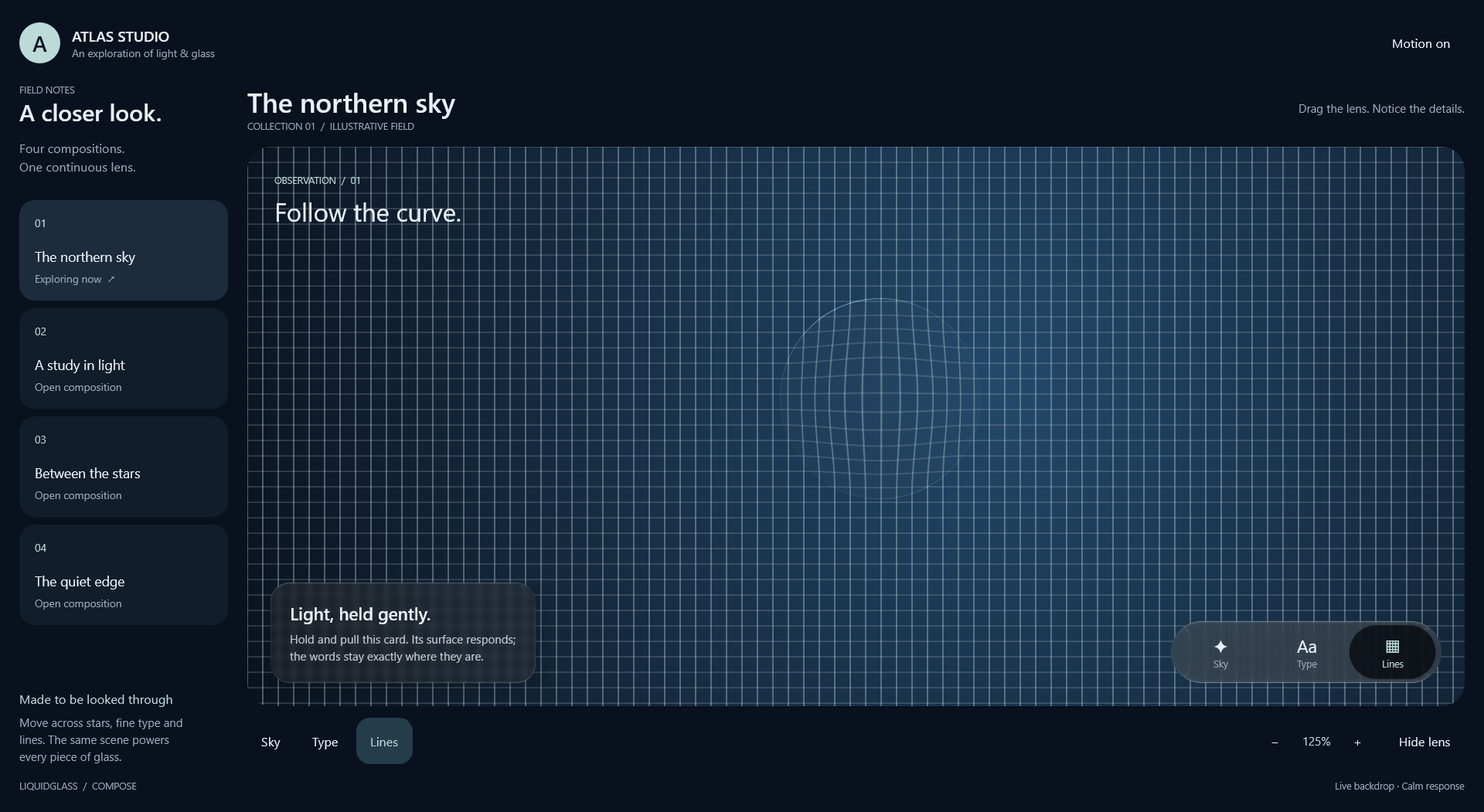
Native app-buffer capture from the clipped-input checkpoint. The grid shows continuous magnification; the card and navigation remain anchored. This resting view is not proof of continuous motion or FPS. Atlas now selects a discrete GPU where available and prints the actual adapter. The owner's tested hybrid machine selected NVIDIA RTX 3050; an OpenGL override selected Intel and was not an equivalent backend comparison. GPU evidence.
Features and integration paths
| Use case | Entry point | Responsibility and scope |
|---|---|---|
| Compose app | LiquidGlassTheme at the root and Modifier.glassEffect |
One recording per theme; the element keeps layout, actions and semantics |
| Compose for Web | the same Compose APIs, wasmJs target |
Same Skia actuals as desktop (skikoMain); :web runs Atlas in the browser (record) |
| Full optical control | Glass(style = GlassStyle(...)), GlassEffectContainer, glassEffectID |
Every optical parameter and the historical presets; the explicit state API was removed on 18 October |
| Free magnifier | GlassStyle.clearLens / native DrawLens |
Continuous mapping; distinct from a held navigation selector |
| Calm navigation | GlassTabBarStyle.Calm() |
Tap/held travel, landing recovery, whole-bar off-axis strain and separate appearance |
| Portable production renderer | CanvasKit createGlassScene / createGlassPainter |
Production shaders, explicit source, density, lifecycle and input |
| Any web page or framework | <liquid-glass> (npm @shayxo.dev/liquidglass) |
HTML engine: the live page, a CSS approximation (refraction in Chromium only); canvas engine: production shaders over a supplied source |
| Lightweight browser lens | ports/web |
Dependency-free lens preview; not the full material |
| Native .NET | GlassPainter, CalmInteraction, GlassFeedback |
SkiaSharp material and whole-surface input; host schedules redraws |
| Existing WinForms controls | ControlBackdrop.Capture |
Owned control subtree only, explicit invalidation/lifetime and supported-type limits |
Compose setup, API, generic interaction, cross-stack contracts and .NET setup/examples. No adapter silently captures the system desktop or another application.
Navigation shape and appearance
13 October: first continuous comparison. Both iOS recordings were replayed gesture by gesture
through the real renderer at a deterministic 60 fps and compared as sequences (taps, stationary
hold, early and formed throws into both walls, held reversals, the soft landing on Contacts).
Five visible defects in the handoff build were corrected in GlassTabBarStyle.Calm():
- a tapped selector now travels as refracting glass instead of fading to an invisible ghost;
- a thrown lens stays formed through travel and the wall impact, then becomes the inset;
- wall landings are a wide flattened capsule, not the tall circle of the former impact model
(kept as
GlassPoseSpec.CalmImpactfor comparison); - the grasp follows a fast throw closely (default 78/s instead of the authored 40/s);
- the held rim is a soft refractive band, not a white specular outline;
and the dark material was recalibrated to the recordings. A second pass added
GlassTabBarAccessory: the held bar now fuses with a neighbouring search button through a liquid
neck, as iOS 26's Phone bar does. A third pass matched fast held reversals: the lens stays under
the finger through Video 2's sweeps and a hold forms in about 80 ms. A fourth pass matched the lens's rim, band glow and
interior clarity, and the bar's rim, to measured grey levels; a fifth gave the moving lens a
reflective rim at its caps and selected ink under the whole lens: bar 45 at rest and 53 held, resting
selector 28 against the reference's 24–30 (previously 6–8). A sixth pass (14 October) made wall
landings press into the bar's end and narrow from behind (241 → 285 px, as measured) instead of
flying past it, and corrected the comparison scene's resting pill to the measured 95 pt. A seventh
pass corrected the inferred input (hold onset and wall-throw lift), enlarged the moving lens's
cap swirl with faint fringes, made the held bar reach toward the finger (edges within 2–5 px of
iOS) and redesigned Atlas Studio. An eighth pass matched the bar's release after lift, so the
search-button neck parts on time. A ninth pass (14 October, second half) scored every wall landing
rather than one: after the lift the trailing edge travels on underdamped (rms 4.9 px over nine
landings, 15.4 before; the 9.9 s landing now narrows like the others), a formed lens presses past
the bar's end as iOS's does, the moving lens's caps draw content out radially (and a clamp that had
halved the rim mirror was fixed), and the search button's neck gives way to an arriving lens. A tenth
pass scored the left-wall landings too (rms 4.1 px); an eleventh made the bar relax while its lens is
dragged, as iOS's does, which brought the search-button neck to a median 0 ms of iOS's (67 before),
and the ports now draw the selected ink inside the selector. A twelfth pass fixed the held lens's
selected ink (scaled about the wrong point, 17 px off) and a frame-loop wake that left throws from a
still hold 1.5 frames behind the finger, made the moving lens widen and flatten as iOS's does
(458 x 145 px at its fastest reversal, ours 427 x 144), gave the held lens a thin grey outline
instead of a white ring, and let a tapped selector bend icons along its top and bottom edges. A
thirteenth placed the held lens on the bar's pressed tab with the bar no longer reaching past it,
restored its inward glow as a floor, and matched the page text seen through it. A fourteenth
matched what the held lens shows of the page beneath it and corrected the inferred reversal
input from the recording's own icon-crossing times. The Calm selector's motion, gestures and material are ported to the
CanvasKit and .NET packages, checked against the Kotlin controller and material factory. On Android, the
selector and Atlas Studio were verified on an API 37 emulator through the AGSL path
(emulator record);
no physical device was available.
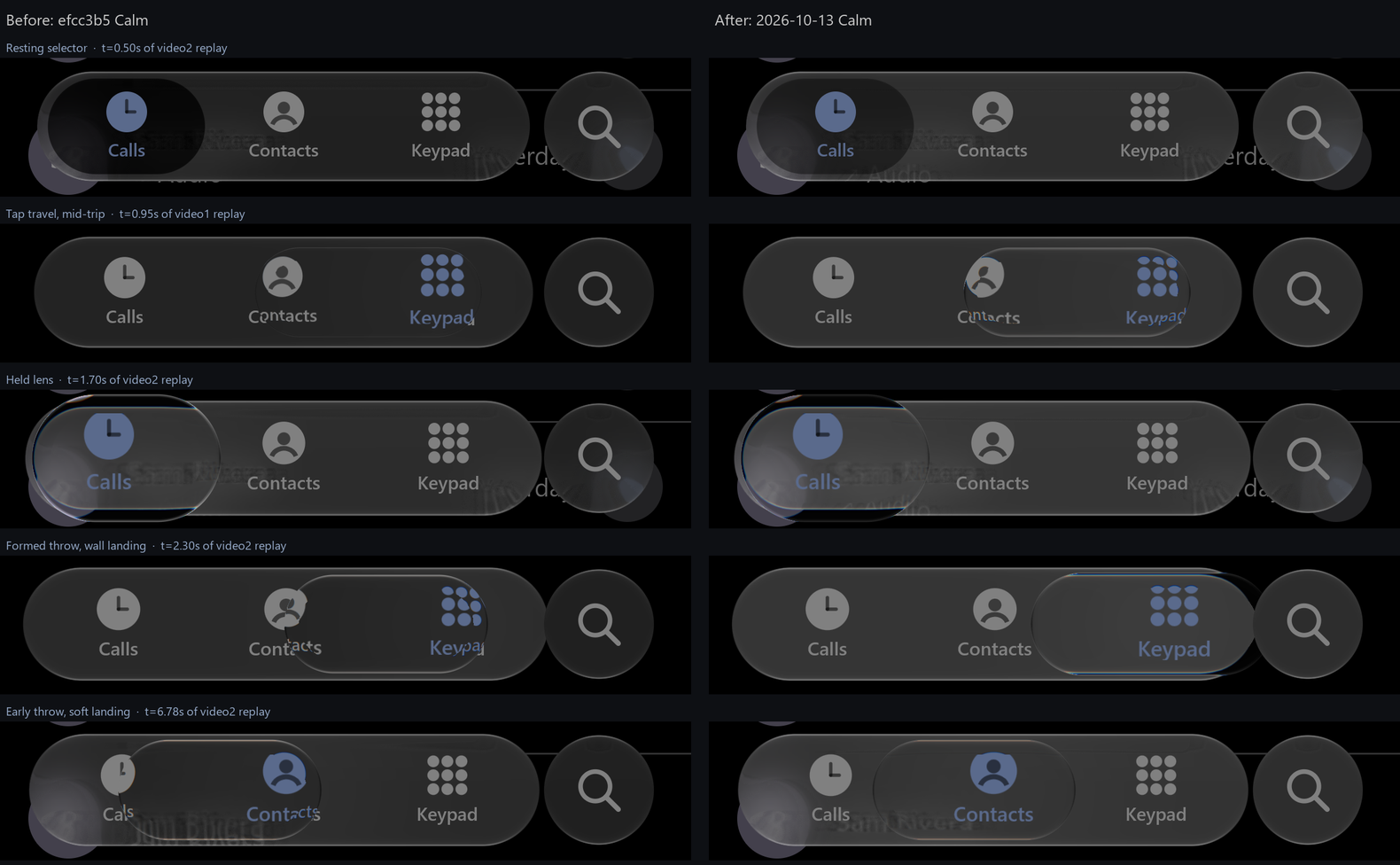
Our renders only; the private reference is not published. Finger timing is inferred from the recordings. Method, numbers and the remaining differences (bar/search fusion while held, weaker stretch on fast reversals, later hold onset, smaller ink magnification in transit, more smeared text under the bar) are in the reference-replay record.
Earlier work this builds on: resting tap travel and held formation are separate; press expansion and whole-bar strain are separate, and the selector gets no independent perpendicular squeeze; layout and hit targets stay fixed. The 12 October tap-appearance calibration (25 interior patches, repeated short-tap width residual up to 20.64 px) predates this comparison and is superseded for tap optics by the change above.
Evidence map
| Change / investigation | Primary record |
|---|---|
| Continuous magnifier, calm controls, Atlas redesign, original extreme envelopes | Stabilization record |
| Coupled short/long tap shape | Paired original/source comparison |
| Both endpoint landings and remaining cap recovery | Landing sequence, shape-aware edge |
| Rejected dark-disc appearance and corrected substrate tint | Native before/after |
| Repeated adjacent-trip timing and residual width error | Short-tap audit |
| Separate tap pigment/ink, calibration and verification | Initial optical audit, candidate, long-tap recovery |
| GPU clipping seam and retained blur/input behavior | Clipped-input regression and native proof |
| Rendering cost, natural recording, retained selection failure | Frame/input investigation |
| Portable production shaders and scene | CanvasKit guide |
| Native .NET material, motion and controls | Painter, calm interaction, native backdrops |
Contact shadow inside the backdrop at renderScale below 1 (fixed 17 October) |
Performance guide, GlassContactShadowScaleTest |
These links are pinned to a published source checkpoint so the evidence remains reproducible. For later status, follow the repository's progress and full checklist.
Native .NET interaction and controls
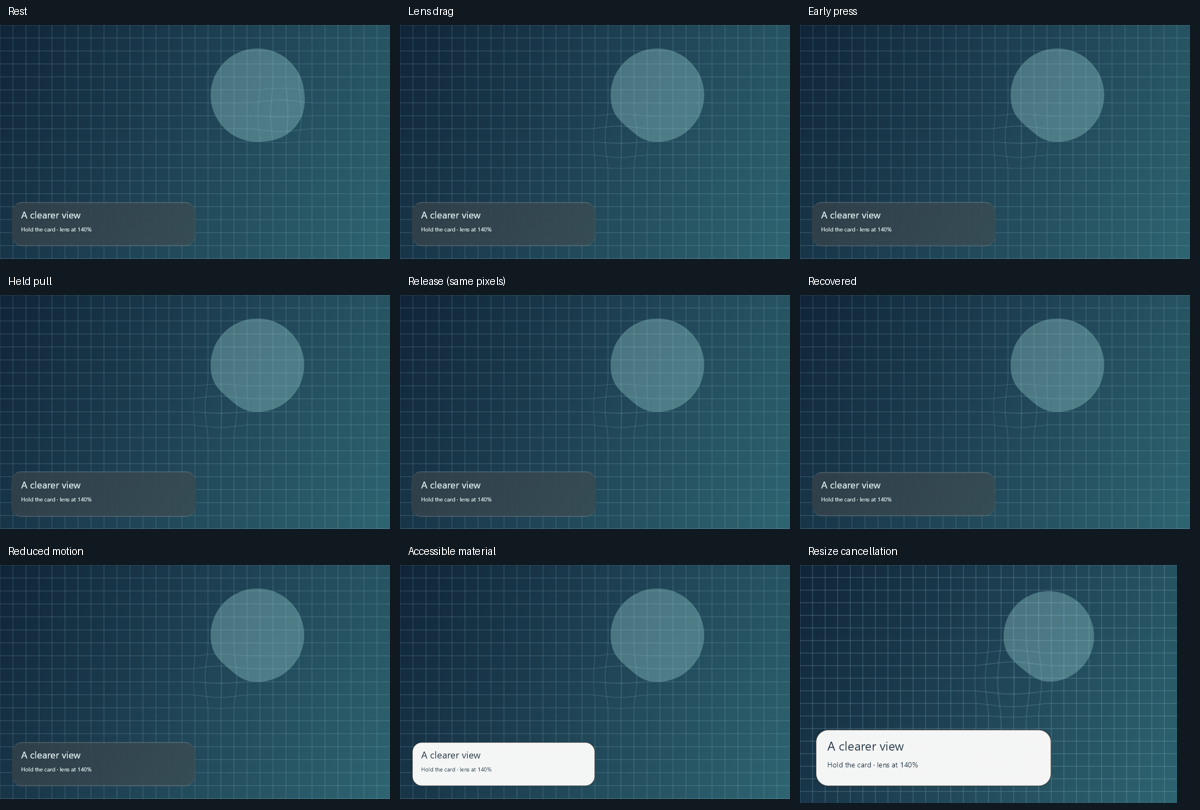
CalmInteraction takes logical bounds, cumulative displacement and monotonic seconds. It preserves
release/re-grab continuity, viewport containment, reduced-motion reset and resize cancellation.
The native implementation matches 144 portable states and 107,520 independent outline probes. Twelve
native check groups and nine app-owned phases pass. Held/release images match exactly; recovery
and reduced motion return to baseline, with 1,092 foreground pixels remaining anchored.
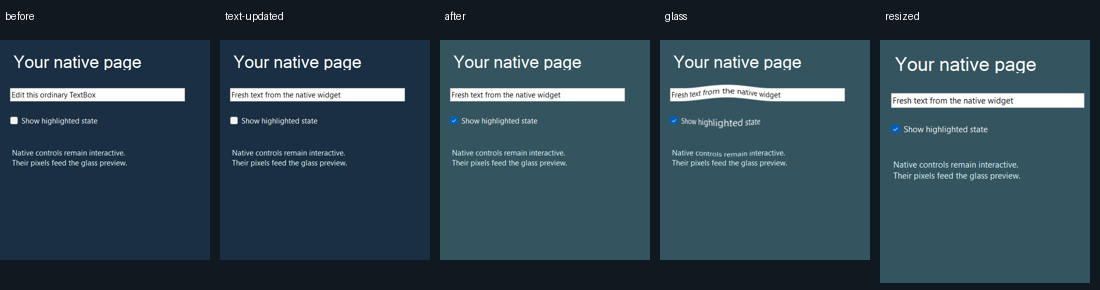
The separate WinForms adapter records an owned Panel/Label/TextBox/CheckBox subtree. Actual TextBox glyph changes alter 1,522 pixels within its bounds, independently of background changes. Identity lens pixels, refraction, resize, retained-source failure and UI-thread checks pass. The example keeps native controls interactive beside their glass preview. RichTextBox/ActiveX are rejected; hidden children, custom controls and overlapping container order retain documented limits.
This completes usable whole-surface feedback and one native control-capture path; the native Calm navigation selector (motion, gestures and the Compose material) is also ported. Additional frameworks, high-level portable refracted foreground, ported selected ink and universal widget capture remain incomplete. No NuGet package was published.
Packaging (18 October): the painter is packed as LiquidGlass and the Windows Forms host as
LiquidGlass.WinForms, at the library's version, with Source Link and symbols. CI packs both on Linux
and Windows and checks each package's readme, NOTICE, licence, version, assembly and embedded shaders.
Publishing waits for the owner.
Verification and performance
| Evidence | What it proves | What it does not prove |
|---|---|---|
| Inspected cea1913 hosted XML: 344 library passes, 27 optional skips, 3 Atlas passes; Android build | Exact regression/build checkpoint | Full iOS equivalence or physical Android validation |
| 43 inspected NVIDIA native motion phases | App-owned rendering and selection/layout assertions | Continuous matching trajectory or presented FPS |
| af333fa: all ten required hosted checks green | Native calm update passes Windows/Linux, docs/security and existing build gates | Later commits need their own CI |
| b46207d: all ten required checks green, including native Windows controls; five local states inspected | Standard-control capture, glyph updates, identity/refraction and failure guards | Other control types, hosts and display performance remain unverified |
| Controlled wide-input old/new/new/old comparison | About 3 ms additional median redraw submission cost | Display latency or all-scene performance |
| Natural recording and JFR | UI picture-recording/dispatch observations; 491 ms Direct3D lock wait inside one forced redraw | GPU execution/presentation timing or a complete lag diagnosis |
The original local V3 gesture timeout is preserved alongside its unchanged-source passing retry. One natural replay failed bottom-right selection; two later observed replays passed. That failure's cause remains unresolved. Windows refused the process-filtered PresentMon ETW session; no display trace was produced and no permission changes were made. See performance.
What remains
- Remaining differences from the continuous comparison: the 9.9 s landing peaks 6 px short of
iOS's and the left width series' first frames narrow up to 11.2 px less, both of the size of one
frame of the inferred lift; the neck parts 100 ms late at one release (34.8 s). In display
colours (since 15 October, five recordings) the rest, held and tap levels are within 0-4 grey
levels; since pass 18 the pill and lens pass page content as iOS's do and text under the bar is
one soft copy. Since 17 October the held lens no longer passes the raw page, so text under it
is veiled as under iOS's; it adds the raw page blurred (
GlassStyle.rawBlur, 0.5 / 50 dp since 18 October), so it lifts over content as iOS's does (text p50 83 against 82, black unchanged); its top band near the rim still reads 11 below iOS's.GlassTabBarStyle.slotWidthlays tabs on set slots as WhatsApp's bar does (all five centres within 2 px), in Compose and both ports.GlassTabBarStyle.CalmClear()is the clearer bar of WhatsApp and the App Store (bar 53 against iOS's 54 over a grey card, Calm 46), in Compose and both ports; withlegibility2.5 it compresses text under it (p50 / p75 67 / 98 against iOS's 69 / 80). WhatsApp's motion lands 14/14 and settles a median 21 ms early, read by one tracker on both sides with inferred input. LightCalm()is measured on the owner's light recording (bar 0.59 of the page + 115, rim, shadow, pill, lens outline, tap optics, and since 18 October the held lens's shadow, cast by the lens rather than its node). The owner's device check (18 October) changed five things: icons hold still on taps, taps travel as a lens, the held lens no longer shows the bar's outline as a second capsule, the search button follows a swipe less, and a held lens joins the search button through a neck; the bar's rounded ends lens what lies beyond them (capFold). The dark held lens is within 4 levels of iOS's in every region (2.8 rms), and the search button's sideways release springs as iOS's does (x damping 0.3). Text under a tab bar is one soft copy in both appearances (IMG_7049), as the Calm presets draw it. The search button presses, pulls and lands as iOS's does since pass 17 (centre 2-3 px rms); the CanvasKit and .NET ports have its press, pull and landing (createFreeButton/FreeButton, checked frame by frame against Kotlin) and, since 17 October, the bar's fusion with it (accessoryFuse/AccessoryFuse). The owner accepted the Calm tab bar on the device on 18 October, by finger, after the six-point check (icons, tap travel, held lens rim, search feel, lens neck, bar ends). - Hardware: the physical-device check ran on 17 October (Pixel 7, dark and light: tap, hold, drag, throw, the search button pulled 250 px in eight directions, off-axis bar drags; no artefacts; record). The owner's own-finger check followed on 18 October and was accepted. Landing timing is within one frame of the 60 fps recordings (WhatsApp's paths: best shift -17 ms, was -42), its resolution; no calibration of the inferred lift moves it further.
- Performance on a wider range of devices (Pixel 7 at 90 Hz keeps the display rate: UI thread 6.9 ms,
GPU 8.5 ms p50 per frame, 2-3% janky;
renderScalebarely changes it; the dark lens's wider raw blur of 18 October adds 2 ms at GPU p90 and nothing at p50). Atlas Studio wide (1400 x 900) and narrow (420 x 880) windows were captured and inspected on both GPUs on 18 October (record): every scene intact, the compact layout under 480 dp as designed; static redraw submission ~10 ms p50 on the NVIDIA RTX 3050 and 21-29 ms on Intel UHD, slower than the 11 October record (4.5 / 8.9 ms). A 14 October build times the same as this one, so the 18 October changes did not cause it; its cause is not established. Owner visual acceptance of the desktop windows is still open. - Additional host integrations, with executable evidence.
- No release/tag is authorized.
The current checklist has 27 completed and 22 open entries of unequal size; this is not a progress percentage. A passing checkpoint does not narrow the full goal.
Keeping this documentation current
Each behavior/API change must update its user guide, this status/evidence map, CHANGELOG and the relevant limitation before publication. Visible changes require app-owned screenshots at stated size/backend, captions that distinguish measured source from candidate output, reproduction commands and an exact verification record. Failed attempts stay labelled and historical claims retain their original scope. Raw/private recordings and full profile traces stay outside the published site. The maintainer checklist is in CONTRIBUTING.